How the Trust is built
The Medical Records Trust is built on a FHIR server: a single, secure home for medical records, held in a global open standard. This page explains what that means, layer by layer, without assuming any technical background.
The short version
- Records are stored in FHIR, the global open standard for health data, which the NHS already uses.
- A FHIR server is far more than a filing format. It is a complete working system for storing, finding, updating and sharing records, and for passing work between organisations.
- You reach the Trust over a private, encrypted connection (a VPN), and sign in once, with the Trust.
- Third-party apps run inside the Trust. They can only reach records through one checkpoint, which checks your permissions every time.
- Every request is written to an audit log against your name, using an international standard.
The layers
Think of the Trust as a building with one entrance. A request from a clinician passes through each layer in turn, from top to bottom, before it reaches a record.
- Clinician. Everything starts with a named person working for a CQC-registered provider.
- VPN. The Trust is not on the open internet. Access is strictly over a VPN, a private encrypted tunnel between your organisation and the Trust. Without it, there is nothing to connect to.
- Trust sign-in. You sign in with the Trust, not with each app. The Trust confirms who you are and gives the app an access token. Think of it as a staff ID badge that carries your name and expires after a short time.
- Third-party app. This is the software you see and use: a GP system, a prescribing tool, a clinic list. Other organisations build these, and the Trust hosts them in its own environment, so the apps come to the records and the records never leave.
- Permissions choke point. Apps can't touch the records directly. Every read and every change goes through this one checkpoint, carrying your token. It checks who you are, where you work, and whether the trustees' rules allow you to see or change this particular record. If not, nothing comes back.
- Audit log. The checkpoint writes down every request, whether it was allowed or refused, against the name of the person who made it.
- FHIR server. Only now does the request reach the records themselves.
The order matters. Because the checkpoint is the only route to the records, and it won't act without a token from the Trust's own sign-in, there is no back door for an app to use.
What is FHIR?
FHIR (said "fire") stands for Fast Healthcare Interoperability Resources. It is a global open standard for health information. Open means that anyone can read it and build on it, and nobody owns it.
It is maintained by Health Level Seven, known as HL7: a non-profit organisation and the global authority on standards for exchanging, integrating, sharing and retrieving electronic health information.
FHIR breaks a medical record into standard building blocks: a patient, a condition, a medication, an allergy, a test result, an appointment, a referral. Each block has an agreed structure, so any FHIR-based software can understand a record written by any other.
The standard is very detailed, and it has two halves. The first is a catalogue of around 150 kinds of record, each defined down to the individual field. The second is a fixed set of ways for software to work with those records: create one, read it, change it, search for it, be told when it changes. Because both halves are standardised, more than 30 different products, open-source and commercial, implement the same thing, and software written for one works with the others.
It is also close to universal. In the United States, the law requires certified health record systems to offer access through FHIR, and the NHS has adopted it as its standard too.
More than a file format
FHIR is often described as a data interchange format: a standard envelope for posting a record from one closed system to another. That description sells it short, and it is the main reason FHIR is underused.
The standard doesn't only define what a record looks like. It also defines how software should store records, find them, change them and act on them. A FHIR server is software that does all of that. It is the filing room and the staff who run it, not just the paper size.
| A FHIR server can | Which means |
|---|---|
| Store the whole record | Problems, medications, allergies, results, letters and appointments all live in one place, in one standard form. |
| Search it | "All patients on this drug", "this patient's last five HbA1c results": answered directly, in a standard way. |
| Keep every version | Nothing is silently overwritten. You can see what a record said last year and who changed it. |
| Pass work between people | Orders, referrals and tasks are records too, so they can be raised by one organisation and picked up by another. |
| Notify | An app can ask to be told when something happens, such as a result arriving. |
| Speak clinical codes | It understands coding systems such as SNOMED CT, so a diagnosis means the same thing everywhere. |
Put together, that is enough to run an entire clinical system, or a whole network of them. An app built on the Trust doesn't need its own private database of patients. It asks the FHIR server. That is what makes it possible to change apps, or use several at once, without moving a single record.
The backbone of a whole health system
Most industries run on a core system that the public never sees. A bank has its ledger: the one place where every account and every transaction is held. The branch counter, the cash machine and the phone app are all just different windows onto it. Replace the phone app and nobody's balance changes.
A FHIR server is that core system for healthcare. It is the backbone that holds everything and keeps it consistent, and the clinical apps are windows onto it. And its catalogue goes well beyond the clinical notes. It covers what a health organisation needs to operate:
| Area | What the standard already defines |
|---|---|
| Clinical care | Problems, medications, allergies, observations, test results, imaging, immunisations, procedures, care plans. |
| Getting work done | Orders, referrals, tasks, and the hand-over of each from one person or organisation to the next. |
| Time and place | Appointments, clinic schedules, free slots, locations, admissions and discharges. |
| People and organisations | Patients, practitioners, their roles, teams, organisations and the services each one offers. |
| Money | Charges, invoices, accounts, and cover or funding arrangements. |
| Governance | Consent, who recorded what and when, and the audit trail. |
That is the scope of record-keeping needed to run a large integrated health system of the kind found in the United States, such as Kaiser Permanente, Johns Hopkins or UPMC, where hospitals, clinics, community care and payment all sit in one organisation. The standard was designed to cover all of it.
The hard part is already done
The most difficult and expensive part of any records system is the core: deciding how every kind of information is structured, storing it safely, keeping its history, and making it searchable. With FHIR, that work has been done, in public, by an international standards body, and built into products that can be used off the shelf.
So the Trust does not have to design or write a records system. It has to choose a FHIR server, run it well, and put the right controls in front of it. That changes what is practical:
- Bringing records in. Data from existing systems can be loaded into the server in a standard form. This is how the Trust starts, with a copy of the record kept up to date from a practice's current system.
- Small apps for single jobs. Because the server does the heavy lifting, an app can be as small as one screen for one task. Small apps are quick and inexpensive to build. They are also far easier to build and assure properly under ISO 13485, the quality management standard for medical devices, than a large all-in-one system is.
- Connecting to existing EHR platforms. The established platforms increasingly speak FHIR themselves, so linking to them is a matter of configuration more than bespoke engineering.
- Working as a network. Organisations that share one server can order from, refer to and book with each other, as described below.
Medicine across organisations
Because every organisation on the Trust works from the same server, care can cross organisational boundaries without letters, faxes or re-keying.
Take a GP ordering a blood test from a separate phlebotomy provider. The order is created as a standard FHIR record. The provider sees it, takes the sample, and the result is filed straight back into the same patient record. No interface between two suppliers had to be built for that to happen.
This is also how the Trust pays for itself. Its income comes from small fees on services ordered through the platform, like that blood test. That only works because a FHIR server can handle the order, the hand-over and the result as one joined-up process. The Trust's revenue depends on FHIR being used as a full system, not as an envelope.
Why FHIR and not openEHR?
You may have heard of openEHR, another open standard for health records. If you remember video tapes, openEHR is Betamax and FHIR is VHS. Betamax was arguably the better-engineered format. VHS was the one everybody had, so it was the one the films came out on.
FHIR has won the standards war. There are more than 30 FHIR servers available, both open-source and commercial, and a thriving ecosystem of tools, apps and people who know how to use them. The NHS already uses it.
The Trust does not intend to use openEHR or integrate with it. In our assessment, openEHR does not yet have the mature, widely available implementations that we would need to build on, and FHIR does.
The audit log
The Trust's audit log follows a published international standard called BALP (Basic Audit Log Patterns). It comes from IHE, Integrating the Healthcare Enterprise, a body that sets out how health IT standards should be applied in practice.
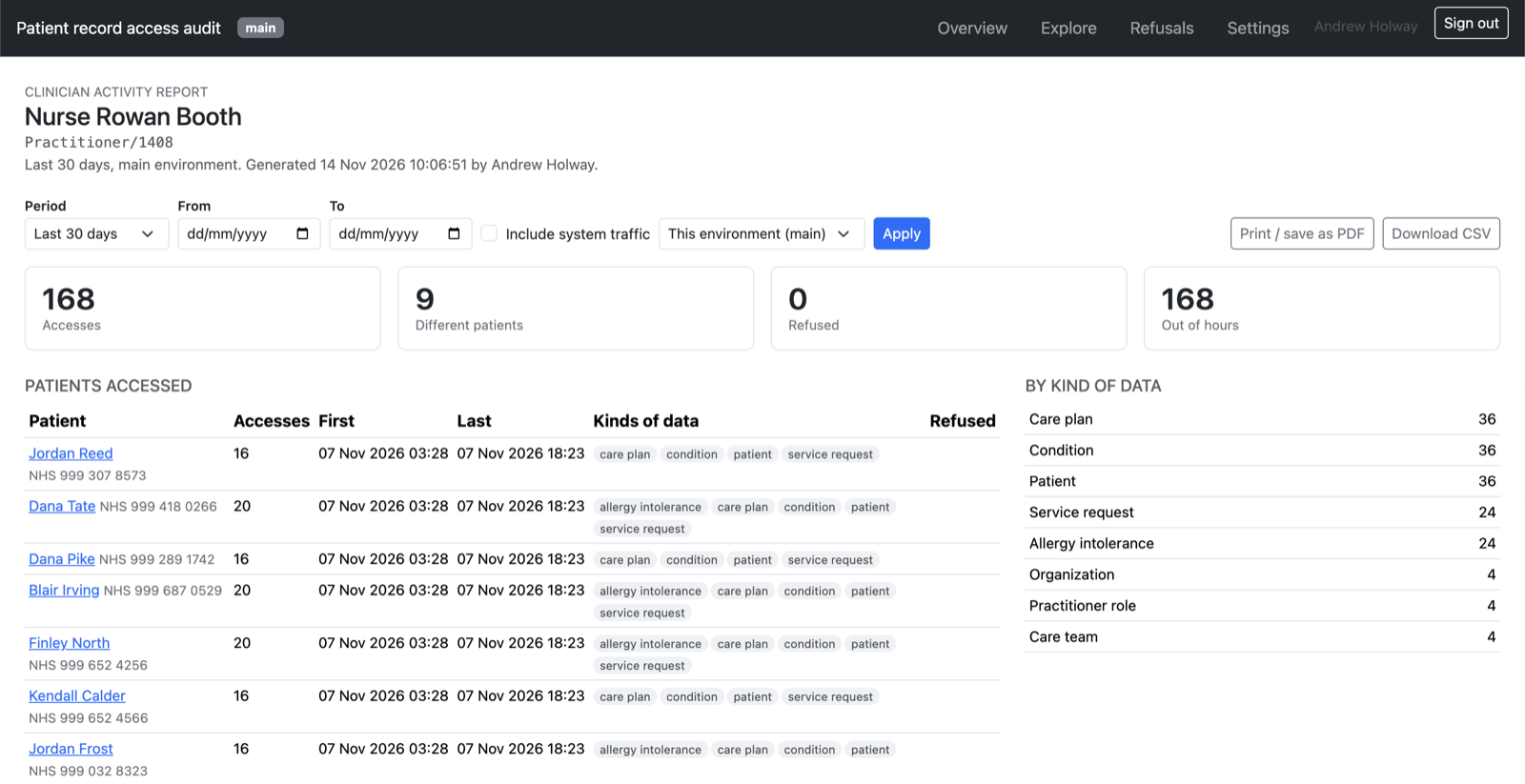
BALP defines exactly what must be written down each time a record is read, created, changed or deleted: who did it, when, to which patient's record, and whether it was allowed. Using a standard means the log can be read and checked by independent tools and auditors, not only by the Trust.
In practice, this means the log can answer two plain questions at any time: who has looked at this patient's record? and what has this clinician looked at?
What about patients?
The Trust's own work is the layer underneath: holding the records and controlling access to them. Apps that give patients access to their own data can be built on the platform by third parties, in the same way as clinical apps, but building and running them is not the Trust's responsibility.